Showing posts with label Human Rights Council. Show all posts

Sunday, September 4, 2011

Amnesty hails Aussie court decision as 'big win' for human rights

Harakahdaily

Sep 2: Amnesty International has welcomed as "a landmark victory for human rights" the High Court decision stopping the Malaysia refugee swap with Australia.

Malaysia's ill-treatment of refugees and migrants is world renowned

The organization has consistently warned the Australian Government that Malaysia is a dangerous destination for asylum seekers and that sending vulnerable people there would violate Australia's obligations under international law.

"Amnesty International is delighted that the High Court has prevented this outrageous, politically-motivated scheme from going ahead," said Amnesty International refugee spokesman Dr. Graham Thom.

"Malaysia is clearly not a safe destination for refugees and asylum seekers, said Thom. "The government should never even have contemplated outsourcing Australia's refugee protection obligations to a country which regularly canes, detains and abuses asylum seekers, and which refuses to sign the U.N. Refugee Convention."

The High Court decision also vindicates Amnesty International's grave concerns that unaccompanied children would be at particular risk if removed to Malaysia, he said.

"As the legal guardian of the unaccompanied minors, the Immigration Minister must act in the children's best interests," said Thom. "Sending them to Malaysia is in blatant breach of the U.N. Convention on the Rights of the Child."

"Now that the High Court has put an end to this sorry saga, it's time for common sense to prevail," added Thom. "Australia should treat all asylum seekers equally, regardless of whether they come by boat or by plane. All asylum seekers should be processed on the mainland in accordance with our obligations under the U.N. Refugee Convention."

Related:

Amnesty welcomes Aussie court's injunction on Malaysia deal

Australia: Malaysia pledges not to cane asylum seekers

Refugee deal with Malaysia to be scrutinised in Aussie parliament

Our Cruelty: Refugees caged and caned in world of pain

Refugees on a hiding to nothing


http://en.harakahdaily.net/index.php/berita-utama/3427-amnesty-hails-aussie-court-decision-as-big-win-for-human-rights.html

Saturday, July 16, 2011

Malaysia: Investigate Crackdown on Pro-Democracy March

Cease Intimidation, Free Detained Activists

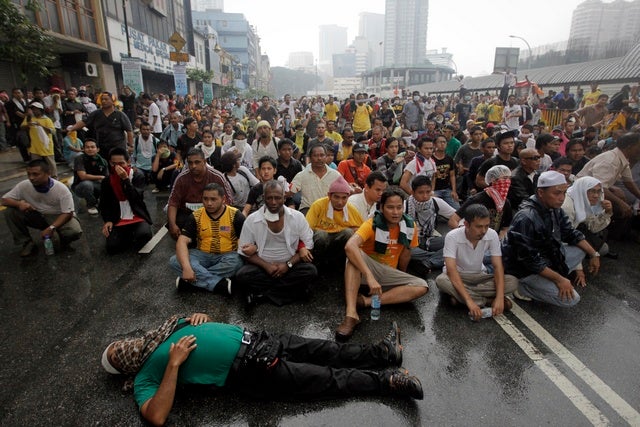
2011_Malaysia_Bersih.jpg

Supporters of the Bersih electoral reform coalition sit on the road as police approach them during clashes in downtown Kuala Lumpur on July 9, 2011.


JULY 13, 2011

(Bangkok) - The Malaysian government should launch a prompt, impartial, and transparent investigation into the use of excessive force and unwarranted arrests by the security forces during a march for electoral reform in Kuala Lumpur on July 9, 2011, Human Rights Watch said today. The government should cease threats and intimidation against the march's sponsor, the Coalition for Clean and Fair Elections (Bersih), and release all those still detained for exercising their rights to free expression, association, and assembly, Human Rights Watch said.

"The Malaysian authorities' crushing of Bersih's march shows that when basic liberties compete with the entrenched power of the state, the government is quick to throw respect for rights out the window," said Phil Robertson, deputy Asia director at Human Rights Watch. "Apparently in Malaysia, freedom of speech, assembly, and association are only permissible when they support the government."

After the government reneged on a compromise that would have allowed a Bersih rally in the main Merdeka Stadium in Kuala Lumpur, Bersih supporters on July 9 took to the streets in a peaceful, well-ordered march. Malaysian security forces responded with water cannons, extensive use of teargas, manhandling of protesters, and 1,697 arrests. Video footage from the media shows the security forces making unprovoked attacks on the marchers.

Prime Minister Najib Razak and Inspector General of Police Ismail Omar denied that the security forces attacked first, however. Home Affairs Minister Hishammuddin Hussein on July 11 threatened action against domestic and international media for what he characterized as "baseless claims."

Since June, Bersih has sought to deliver a petition to Malaysia's king outlining its eight proposed election reforms, including free and fair access to the mainstream press, a minimum 21-day election campaign period, and a cleanup of the electoral rolls. The government has responded with a campaign to discredit the coalition and deter participation in its activities.

The United Nations Basic Principles on the Use of Force and Firearms by Law Enforcement Officials calls upon law enforcement officials to, as far as possible, apply nonviolent means before resorting to force. Whenever the lawful use of force is unavoidable, law enforcement officials are to use restraint and act in proportion to the seriousness of the offense.

Although all those arrested on July 9 were released later that evening, Hishammuddin left open the possibility that they could still be charged with criminal offenses. "Of those who were arrested, the AG's [attorney general's] Chambers is currently studying the seriousness of their offenses to determine whether to charge them or not," he said, singling out the Bersih chairwoman, Ambiga Sreenevasan. He also made unsubstantiated accusations against Bersih about involvement with weapons caches and receiving funds from overseas.

Six leading members of the Socialist Party of Malaysia (PSM), who were pulled off their bus on June 25 on the way to a political rally, remain in preventive detention under the Emergency (Public Order and Crime Prevention) Ordinance, which permits the police to hold them for 60 days without charge. Hishammuddin said their detention is connected to a "subversive issue" yet provided no additional information.

"Malaysia's allies should press the government to stop its harassment of Bersih, release all peaceful activists still detained, and engage in a constructive dialogue with election law reformers," Robertson said.

Human Rights Watch urged the government to free immediately and unconditionally the 6 detained Socialist Party members, rescind the charges against another 24 party members already released on bail, and to stop using preventive detention legislation, such as the Emergency Ordinance, against peaceful protesters.

In addition to pre-rally arrests of the Socialist Party members, the government invoked the Societies Act, the Sedition Act, the Police Act, and the Printing Presses and Publication Act to arrest some 270 supporters for wearing or selling Bersih's distinctive yellow T-shirts, printing or possessing Bersih posters, or promoting the coalition's aims at public meetings. Police also raided the Bersih office, seized computers, and arrested staff, and called in organizers and other prominent supporters for interrogation. The government should rescind the Ministry of Home Affair's July 1 determination that Bersih is an illegal organization under the Societies Act, Human Rights Watch said.

Article 10 of the Federal Constitution of Malaysia recognizes the rights to freedom of association, peaceful assembly, speech, and expression that are enshrined in the Universal Declaration of Human Rights. In seeking a seat on the United Nations Human Rights Council, Malaysia pledged in an official communication to other governments on March 9, 2010, that it "reaffirms its full commitment to the promotion and protection of human rights at both the domestic and international levels."

"The Malaysian government's promise to fulfill its international obligations as a UN Human Rights Council member faces an acid test in the coming days and weeks," Robertson said. "Malaysia's international friends need to let Prime Minister Najib know that he is leading his country down the wrong path."


The Malaysian authorities’ crushing of Bersih’s march shows that when basic liberties compete with the entrenched power of the state, the government is quick to throw respect for rights out the window. Apparently in Malaysia, freedom of speech, assembly, and association are only permissible when they support the government.

Phil Robertson, deputy Asia director at Human Rights Watch


http://www.hrw.org/en/news/2011/07/13/malaysia-investigate-crackdown-pro-democracy-march

Friday, February 25, 2011

UN official: World should act on Libya crackdown


The empty seats of the Libyan delegation are pictured before the Human Rights Council holds a Special Session on the situation of the human rights sit AP – The empty seats of the Libyan delegation are pictured before the Human Rights Council holds a Special …

GENEVA – The U.N.'s top human rights official warned Friday that mass killings in Libya, possibly of thousands, require the world to "step in vigorously" and immediately end a brutal crackdown on anti-government protesters in the North African country.

As Libya faces growing diplomatic pressure from around the world, the U.N. High Commissioner spoke with the most urgency yet by a U.N. official, citing estimates that thousands may have died at the hands of Libyan leader Moammar Gadhafi's security forces, possibly amounting to crimes against humanity.

"The crackdown in Libya of peaceful demonstrations is escalating alarmingly with reported mass killings, arbitrary arrests, detention and torture of protesters," Navi Pillay told the U.N. Human Rights Council during a daylong emergency meeting. "Tanks, helicopters and military aircraft have reportedly been used indiscriminately to attack the protesters. According to some sources, thousands may have been killed or injured."

Diplomats on the 47-nation council debated whether to call for Libya's ouster from the council, in what would be an unprecedented suspension of one of its own members. It will also decide whether to heed Pillay's call for an independent U.N.-led probe of abuses in Libya.

It was only last May that the former U.S. enemy was elected to the Geneva-based body as part of a series of attempts at political rehabilitation on the world stage.

"The world is watching you, the world will hold you to account," British Prime Minister David Cameron told reporters Friday, referring to Gadhafi's regime. "International justice has a long reach and a long memory."

U.N. Secretary-General Ban Ki-moon also was to meet with the powerful U.N. Security Council later Friday in New York to consider possible sanctions against Libya.

European nations were leading the effort to condemn Gadhafi's regime that has ruled for 42 years but now appears to have lost control of large parts of the country. Pillay reminded the council that Gadhafi had urged his supporters to battle protesters and "attack them in their lairs."

"Any official, at any level, ordering or carrying out atrocities and attacks can be held criminally accountable," she said.

It is the first time that the Geneva-based council has held a special session to scrutinize one of its members. Libya's ambassador did not attend, but some of its allies spoke out against sudden measures to punish Gadhafi.

Nigeria and China were among those who condemned the violence but rejected the call to suspend Libya from the council.

Pakistan's ambassador, Zamir Akram, said the 57 members of the Organization of the Islamic Conference "strongly condemn the excessive use of force" in Libya.

"Muslims will no longer tolerate inequalities and injustice," he told the council. "A new dawn has come. The rules of the game have changed. Those who do not embrace it will be swept away."

Akram made no mention of supporting Libya's suspension from the council.

Gadhafi's response to the uprising in his country has been the harshest by any Arab leader in the wave of protests that has swept the Middle East recently, toppling the presidents of Libya's neighbors Egypt and Tunisia.

But observers of the Human Rights Council say African and Asian nations are wary of setting too strong a precedent that could be used against other human rights abusing regimes in future.

Suspending Libya's "rights of membership" under the rules for the council would require two-thirds approval of all the 192 countries in the U.N. General Assembly in New York.

Human rights activists said they expect a strongly worded resolution to pass, though it might be watered down by efforts to achieve the broadest possible consensus.

While efforts to ostracize Libya from the council are being driven by Europe, the United States and some Latin American countries, Asian and African nations will be wary of setting a precedent that can be used against them or their allies in future, said Peter Splinter of Amnesty International.

"This is a test of the council and the willingness of some of its more active members, such as Pakistan, South Africa, Cuba, Saudi Arabia, to take a principled stand on human rights," he said.

In Brussels, NATO planned to hold an emergency meeting Friday to consider the deteriorating situation in Libya. It had received no requests to intervene and said it would only do so if it were given a United Nations mandate.

The U.N. Security Council also planned to meet later Friday in New York to consider actions against Gadhafi's regime.

French Foreign Minister Michele Alliot-Marie said France and Britain would press the Security Council for a "total embargo on weapons as well as sanctions, and also the referral of a case to the International Criminal Court for crimes against humanity."

The Security Council rarely does so, but ordered an investigation into crimes in Darfur in 2005.

German Foreign Minister Guido Westerwelle said Friday that Europe was united behind sanctions against Libya and called for swift EU and U.N. action. He laid out an initial sanctions plan that would include an embargo on weapons and goods that could be used to oppress protesters, and asset freezes and a travel embargo on Ghadafi's family.

"This regime in Libya is lashing out madly, it is waging war against its own people," he said in an interview with WDR radio Friday.

The EU's foreign policy chief Catherine Ashton also said the Security Council must "take action" and the EU bloc should consider imposing travel restrictions and asset freezes to achieve a halt to the violence there and move toward democracy.

The United States backs suspending Libya from the Human Rights Council and also is considering a larger sanctions package that might include asset freezes and travel bans on senior Libyan officials, or a ban on the sale of U.S. military equipment.

"The council's responsibility is even greater when the violator is one of its own members," the U.S. ambassador to the council, Eileen Chamberlain Donahoe, said.

A petition released Friday signed by 63 non-governmental organizations around the world called on the General Assembly to remove Libya from the Human Rights Council. Peggy Hicks, Human Rights Watch's global advocacy director in New York, said the credibility of both U.N. bodies is at stake.

____

Associated Press reporters across Europe contributed to this story.


http://news.yahoo.com/s/ap/20110225/ap_on_re_eu/libya_diplomacy

Tuesday, February 8, 2011

Kajian: Kedaulatan undang-undang semakin buruk

Kajian: Kedaulatan undang-undang semakin buruk
Feb 7, 11 7:18pm

Kedaulatan undang-undang di Malaysia menjadi semakin buruk tahun lepas, demikian menurut kajian yang menyenaraikan kedudukan 16 negara Asian mengikut tahap kebebasan masing-masing.

Laporan Petunjuk Kebebasan Asia 2010 juga memberikan lebih markah kepada Malaysia daripada aspek kebebasan badan kehakiman, dengan 5.3 mata berbanding hanya 3 pada 2009.

azlanBagaimanapun, ia menyatakan kebebasan mahkamah masih kuat dipengaruhi kerajaan melalui badan eskekutif.

Daripada skala 1 sampai 10, Malaysia juga terus teruk dalam melindungi hak asasi manusia yang jatuh menjunam daripada 5 mata pada 2009 kepada 1.72 mata pada 2010.

Laporan itu mengukur kebebasan daripada perspektif liberal dan mengumpulkan data daripada index yang dihormati yang memberi kesan kepada kepercayaan liberal.

Dikeluarkan oleh Yayasan Friedrich Naumann untuk Kebebasan (FNF) yang berpengkalan di Jerman, ini merupakan edisi kedua laporan tahunan yang dikeluarkan sejak 2009.

Laporan itu turut menyatakan "kekurangan yang hebat dari segi perlindungan hak asasi" di Malaysia, merujuk kepada pelaksaan hukuman bunuh dan penghukuman berdasarkan orientasi seksual, dengan menyebut perbicaraan kes Ketua Pembangkang Datuk Seri Anwar Ibrahim.

[Baca berita penuh]

http://malaysiakini.com/news/155437

Sunday, February 6, 2011

Saudi moves to curb fathers who abuse their rights

Arab News

RIYADH, Feb 6: Well-known Saudi family lawyer Sultan bin Zahim has come out strongly in support of an effort by the government's Human Rights Commission (HRC) to define a man's abuse of his role in his daughter's marriage as a form of human trafficking.

This abuse is called adhl (prevention in Arabic) and is referred to in Chapter 2, Verse 232 of the Holy Qur'an. A father who prevents his daughter from marrying a suitor who is otherwise considered an acceptable husband as defined in Shariah commits this crime.

The crime may also be committed by a woman's legal guardian, or wali, in the absence of the father. A common motive for committing adhl is a father's desire to maintain control of and access to an employed daughter's income.

Guardians also deny marriage on the basis of a suitor's tribal affiliations. Islam does not define perceived tribal incompatibility as a legitimate reason for a father to deny a daughter's desire to marry a suitor.

Last month, the HRC announced its effort to include the crime of adhl in the Kingdom's official definition of human trafficking, which would codify a punishment of up to 15 years in prison and a fine of up to SR1 million to any guardian found guilty of preventing a woman's right to marry a man otherwise deemed acceptable by Shariah. The punishment would also include revoking guardianship for men who abuse this control.

The HRC is also seeking to include forced marriage as a human trafficking crime. A common motive for forced marriage is a father's attempt to strengthen bonds between families or friends, often in exchange for a dowry that the father steals from his daughter.

Bin Zahim told Arab News that adhl should be considered a matter of the public's right to prevent the socially corrupting spread of marriage prevention or marriage against a woman's will, which are both considered crimes in Islam. Saudi jurisprudence defines crimes as violations of private rights, public rights, or both.

Saudi Arabia's human trafficking law was established in 2009. The HRC has said it dealt with 33 cases related to adhl or forced marriage in 2010. The HRC has also called on the courts to expedite pending adhl cases. When women contest their guardianship, they often end up in government shelters until a court can reassign guardianship, typically to an uncle or brother.

This effort comes at a time when Saudi Arabia is also debating the establishment of a minimum marriage age of 18 in order to stem the habit of marrying off young girls. The age limit has been hotly debated, with some suggesting it should be 15, which is a common age used in delineating a minor from a young adult. The logic behind establishing an age of consent is based on the understanding that a girl is incapable of providing consent to marriage. Forced marriage often involves pre-teen girls compelled to marry old men.

http://en.harakahdaily.net/index.php?option=com_content&view=article&id=2222:saudi-moves-to-curb-fathers-who-abuse-their-rights&catid=37:world&Itemid=59

Friday, March 19, 2010

Kemelut wanita Lebanon


LEBANON ialah sebuah negara kecil yang kaya dengan pemandangan indah.


SAMIRA Soueidan merokok di depan rumahnya di Beirut, Lebanon sambil mengenang saat hakim memutuskan anaknya akan mendapat kerakyatan negara tersebut, kemenangan pertama bagi wanita tempatan yang berkahwin dengan warga asing di negara kecil Mediterranean itu.

Namun, kemenangan itu tidak kekal apabila rayuan membantah keputusan tersebut diterima mahkamah. Kisah Samira adalah salah satu daripada kemelut yang dihadapi oleh ribuan wanita Lebanon yang berkahwin dengan rakyat asing, namun undang-undang menghalang teman hidup atau cahaya mata mereka daripada mendapat kerakyatan.

"Semasa peguam saya menelefon dan memberitahu hakim memihak pada saya selepas turun naik mahkamah selama sembilan tahun saya sangat gembira.

"Undang-undang kami tidak adil dan langsung tidak mempedulikan wanita," kata ibu tunggal berusia 48 tahun itu yang pernah berkongsi hidup dengan seorang rakyat Mesir dan dikurniakan empat orang anak.

Samira mengenang nasib diri di kediamannya di kawasan kejiranan kelas pertengahan di kota Beirut.

Undang-undang yang dikuatkuasakan pada 1925, 18 tahun sebelum Lebanon mendapat kemerdekaan dari Perancis, hanya membenarkan lelaki yang berkahwin dengan warga asing mendapatkan kerakyatan untuk isteri dan anak mereka.

Ia dilihat tidak adil kerana anak-anak berbapakan warga asing yang dilahir dan dibesarkan di Lebanon berdepan dengan kesukaran perundangan dan sosial selain disisihkan oleh tanah kelahiran sendiri.

"Setiap tahun saya terpaksa mendapatkan permit untuk anak-anak saya. Saya perlu mencari duit untuk membayarnya, malah ia perlu melalui proses soal siasat.

"Pernah satu ketika dulu, saya gagal mengumpul wang dan pihak berkuasa mengugut akan menghantar anak saya ke Mesir, negara yang tidak pernah mereka jejaki. Saya terpaksa meminjam daripada lintah darat untuk menyelesaikan masalah tersebut," ujar Samira yang bekerja sebagai tukang cuci selepas kematian suami pada 1994.

Bagaimanapun, usaha kumpulan hak asasi dan pertubuhan wanita untuk mengubah undang-undang tersebut mendapat perhatian tahun lalu dengan draf perundangan sedang dipertimbangkan di Parlimen.

Kempen sama yang dilancarkan di tiga buah negara Arab lain iaitu Algeria, Mesir dan Maghribi berjaya membuahkan hasil.


SAMIRA SOUEIDAN (dua dari kanan) memegang pasport Lebanonnya. Duduk bersama Samira sambil menunjukkan sijil kelahiran ialah anak-anaknya (dari kiri) Faten, Mohammed dan Samir.


Mereka yang menentang pindaan undang-undang itu di Lebanon adalah daripada kem minoriti Kristian yang mendakwa jika hak tersebut diberi kepada wanita ia akan mengganggu keseimbangan demografi negara itu.

Hak asasi wanita

Nisbah penduduk Islam di Lebanon adalah 64 peratus berbanding Kristian hanya 35 peratus.

Timbul juga kebimbangan pindaan undang-undang membolehkan kerakyatan diberi kepada ramai pelarian Palestin yang berkahwin dengan wanita Lebanon.

Hakim John Qazzi yang sebelum ini membuat keputusan yang memihak kepada Soueidan berkata, perdebatan mengenai isu itu adalah bermotifkan politik dan memberi gambaran jelas pendekatan tidak adil Lebanon terhadap hal ehwal wanita.

"Ia tiada kaitan dengan kerakyatan, ia adalah berkenaan hak asasi wanita. Ahli politik Lebanon melihat kaum Hawa sebagai rakyat yang tidak matang," ujar beliau.

Hripsmeh Arkanian, 59, yang berumah tangga dengan seorang pelarian Palestin dan dikurniakan dua orang anak juga bersetuju dengan pandangan hakim itu.

"Sudah lama saya tidak mengundi. Jika undi saya dikira, kenapa suara saya tidak didengari?

"Jika undi saya sama dengan undi lelaki, maka perkara sama perlu dibuat terhadap pemberian kerakyatan," katanya ketika ditemui di rumahnya di pinggir Beirut.

Ujar Hripsmeh, pihak pentadbiran tempatan sengaja menyusahkan anak lelakinya yang terpaksa keluar dan menetap di Abu Dhabi, Emiriah Arab Bersatu (UAE).


HRIPSMEH ARKANIAN


"Saya melawatnya baru-baru ini dan mendapati nada dering telefon bimbitnya adalah lagu kebangsaan Lebanon. Ia menyebabkan air mata saya menitis kerana dia begitu menyayangi negara ini.

"Tetapi negara ini menganggapnya orang asing walaupun ibunya berketurunan Lebanon dan dia sendiri dibesarkan di sini," luah Hripsmeh.

Pakar sosiologi, Fahmiyeh Sharaffedin yang menerbitkan kajian mengenai isu kerakyatan itu pada 2008 bingung dengan diskriminasi yang dihadapi oleh wanita Lebanon walhal perlembagaan memberi hak sama rata antara lelaki dan wanita.

"Negara lain mengenakan sekatan kerakyatan yang lebih ketat, namun ia tidak memilih jantina. Saya tidak faham kenapa kebimbangan dikenakan pada wanita saja dan bukannya lelaki.

"Mengapa lelaki Lebanon boleh berkahwin dengan rakyat asing, mempunyai anak dan meramaikan lagi rakyat negara ini baik Kristian mahupun Islam. Mengapa tidak wanita?

"Kami akan memperjuangkan kesamarataan dan tidak akan menerima apa jua perkara yang kurang daripada itu," tegas Fahmiyeh penuh semangat. - AFP

http://www.kosmo.com.my/kosmo/content.asp?y=2010&dt=0319&pub=Kosmo&sec=Rencana_Utama&pg=ru_02.htm

Sunday, June 21, 2009

Wajib berseluar dalam di Florida


SEBUAH bandar kecil di Florida dekat sini, Broolsville memperkenalkan peraturan baru yang buat kali pertama mewajibkan setiap penduduk tidak kira jantina supaya memakai seluar dalam sewaktu bertugas.

Namun undang-undang kecil yang digubal itu mencetuskan pertikaian di kalangan penduduknya dan didakwa sebagai melanggar kebebasan. Malah, peraturan baru itu melarang pakaian dalam untuk dipertonton secara terbuka.

Turut dipinda ialah peraturan yang mewajibkan pekerja memakai deodoran bagi menghilangkan bau busuk ketiak di dalam pejabat. Selain itu, mereka dilarang memakai anting-anting di telinga dan pakaian yang berbaur lucah.

Pihak dewan bandaran menegaskan penduduk yang melanggar undang-undang kecil itu boleh dihukum denda. Bagaimanapun, Datuk Bandarnya, Joe Bernadini menentang pindaan itu sebagai mencabuli hak asasi manusia. – Agensi

http://www.kosmo.com.my/kosmo/content.asp?y=2009&dt=0621&pub=Kosmo&sec=Dunia&pg=du_05.htm

Thursday, February 12, 2009

Malaysia under fire at UN over refugees

Agence France-Presse - 2/11/2009 5:49 PM GMT

Malaysia under fire at UN over refugees

Malaysia was taken to task by some Western countries on Wednesday over its treatment of asylum seekers and refugees, during a United Nations review of its human rights record.

Belgium, Britain and the Netherlands were among the nations that expressed "concerns" surrounding refugees and asylum-seekers held in detention in Malaysia, as they called on Kuala Lumpur to develop legislation that distinguishes asylum seekers from irregular migrants.

"We note serious problems faced by refugees, migrants and asylum seekers in Malaysia... that is linked to a lack of clarity on their status in the country," Belgium's representative told the UN Human Rights Council during a universal periodic review session.

Under universal periodic review, all 192 member states of the United Nations have their human rights record vetted by the council once every four years.

The session is based on three reports, one submitted by the country under review, and two summaries compiled by the UN Office of the High Commissioner of Human Rights.

The high commissioner's report noted the lack of national legislation on refugees as well as absence of laws on the rights of migrant workers.

In addition, it said, "many asylum seeking and refugee children, among them Muslim children from a nearby country, including the Rohingya refugee children who had lived in Malaysia since 1990s, lacked access to formal education."

The secretary general of Malaysia's foreign ministry Rastam Mohd Isa said in his opening remarks that Malaysia prosecutes only refugees who have committed crimes.

Foreign workers are accorded the same rights as local workers, and the rights of illegal immigrants are protected, he added.

Human rights groups have accused Malaysia of mistreating millions of foreign workers who live there, as well as asylum-seekers, including thousands from nearby Myanmar, which is under military rule.

Human Rights Watch had singled out a government-backed volunteer force in Malaysia known as RELA for allegedly beating, threatening and extorting money from migrants and asylum-seekers.

During Wednesday's session, some countries, including Chile and France, encouraged Malaysia to eliminate discrimination due to sexual orientation and to "respect the human rights of all individuals, including homosexuals."

http://news.my.msn.com/regional/article.aspx?cp-documentid=2463537
Related Posts Plugin for WordPress, Blogger...